Trie Autocomplete (LLD)#
Trie autocomplete LLD design uses a prefix tree where each node holds children keyed by next character plus a cache of the top-K completions through that prefix. suggest(prefix, k) walks the trie character by character and returns the cached list at the terminal node, making lookup O(prefix length).
classDiagram
  class Trie {
    -root : TrieNode
    -k : int
    +insert(word, weight) void
    +search(word) bool
    +suggest(prefix, k) List~Suggestion~
    +incrementFrequency(word) void
  }
  class TrieNode {
    -children : Map~char, TrieNode~
    -isEnd : bool
    -word : string
    -frequency : long
    -topK : List~Suggestion~
    +addSuggestion(s) void
  }
  class Suggestion {
    +word : string
    +score : double
  }
  Trie --> TrieNode
  TrieNode --> Suggestion : caches top K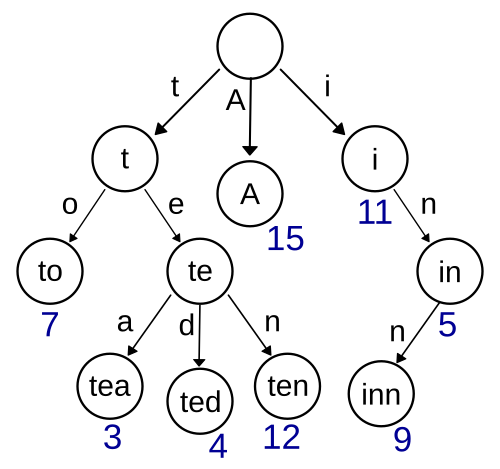
Without caching, autocomplete would walk every descendant of the prefix node to find the K best: O(descendants) per query, too slow at scale. The cache trades insert-time cost (propagate upward) for query-time speed (single lookup).
Ranking by frequency: every search increments the leaf's frequency; the cache stores Suggestion(word, score) sorted by score descending. Weight aging: multiply all frequencies by 0.99 every hour so trending queries surface and stale ones fade. This is read-mostly, so a copy-on-write trie or ReadWriteLock keeps queries lock-free.
classDef service fill:#fef3c7,stroke:#92400e,stroke-width:1px,color:#0f172a;
classDef datastore fill:#fee2e2,stroke:#991b1b,stroke-width:1px,color:#0f172a;
classDef cache fill:#fed7aa,stroke:#9a3412,stroke-width:1px,color:#0f172a;
Trie autocomplete LLD is the workhorse of search suggestion: every typed character returns a fresh top-10 in under 10ms across millions of queries. This guide builds the data structure, the cached top-K, and the read-mostly concurrency story.
Problem statement (interviewer prompt)
Design the in-memory data structure that powers search autocomplete. Support insert(word, weight), suggest(prefix, k) returning the top-K words by score, and incrementFrequency(word) when a user clicks a suggestion. Discuss how to keep suggest O(prefix length), how to age weights, and how to handle concurrent reads with occasional writes.
Requirements#
Functional
insert(word, weight): add a word with an initial weight.suggest(prefix, k): return top-K words starting with prefix, sorted by score descending.incrementFrequency(word): bump score when user clicks.- Optional
delete(word).
Non-functional
suggestO(prefix length) using cached top-K per node.- Read-mostly: thousands of reads per write.
- Memory bounded: cache at most K per node.
- Periodic weight aging (anti-staleness).
Class design#
classDiagram
  class Trie {
    -root : TrieNode
    -k : int
    -lock : ReadWriteLock
    +insert(word, weight)
    +suggest(prefix, k) List~Suggestion~
    +incrementFrequency(word, delta)
    +delete(word)
    +ageAll(factor)
  }
  class TrieNode {
    -children : Map~Character, TrieNode~
    -isEnd : bool
    -word : string
    -frequency : double
    -topK : ArrayList~Suggestion~
    +updateTopK(s, k)
  }
  class Suggestion {
    +word : string
    +score : double
    +compareTo(o) int
  }
  Trie --> TrieNode
  TrieNode --> Suggestion
topK is an ArrayList (small, cache-friendly) sorted by score descending. K is usually 10. Memory per node: ~10 references plus the children map.
Core flow#
sequenceDiagram
  participant U as User
  participant A as Trie
  participant N as TrieNodes
  Note over A: insert("apple", 5)
  U->>A: suggest("ap", 5)
  A->>N: walk root.children['a']
  N-->>A: node_a
  A->>N: walk node_a.children['p']
  N-->>A: node_p
  A-->>U: node_p.topK (precomputed)
  Note over A: incrementFrequency("apple", 1)
  U->>A: click "apple"
  A->>N: walk to leaf "apple", freq += 1
  A->>N: propagate topK up to root
The hot path is the walk: 2 character lookups for "ap". The slow path is insert and increment, which propagate upward, costing O(word length * K).
Code#
import threading
from typing import Optional

class Suggestion:
    __slots__ = ('word', 'score')
    def __init__(self, word: str, score: float):
        self.word = word
        self.score = score
    def __lt__(self, other): return self.score > other.score  # max-first

class TrieNode:
    __slots__ = ('children', 'is_end', 'word', 'frequency', 'top_k')
    def __init__(self):
        self.children: dict[str, 'TrieNode'] = {}
        self.is_end = False
        self.word: Optional[str] = None
        self.frequency = 0.0
        self.top_k: list[Suggestion] = []

    def update_top_k(self, s: Suggestion, k: int) -> bool:
        """Insert s into top_k sorted by score desc; return True if list changed."""
        for i, existing in enumerate(self.top_k):
            if existing.word == s.word:
                if existing.score == s.score: return False
                existing.score = s.score
                self.top_k.sort()
                return True
        if len(self.top_k) < k:
            self.top_k.append(s)
            self.top_k.sort()
            return True
        if s.score > self.top_k[-1].score:
            self.top_k[-1] = s
            self.top_k.sort()
            return True
        return False

class Trie:
    def __init__(self, k: int = 10):
        self.root = TrieNode()
        self.k = k
        self.lock = threading.RLock()  # writer lock; readers use COW snapshot

    def insert(self, word: str, weight: float = 1.0) -> None:
        with self.lock:
            node = self.root
            path = [node]
            for ch in word:
                node = node.children.setdefault(ch, TrieNode())
                path.append(node)
            node.is_end = True
            node.word = word
            node.frequency = max(node.frequency, weight)
            s = Suggestion(word, node.frequency)
            for n in path:
                n.update_top_k(s, self.k)

    def suggest(self, prefix: str, k: int) -> list[Suggestion]:
        # Lock-free read: the worst case is a slightly stale top_k.
        node = self.root
        for ch in prefix:
            node = node.children.get(ch)
            if node is None: return []
        return node.top_k[:k]

    def increment_frequency(self, word: str, delta: float = 1.0) -> None:
        with self.lock:
            node = self.root
            path = [node]
            for ch in word:
                node = node.children.get(ch)
                if node is None: return
                path.append(node)
            if not node.is_end: return
            node.frequency += delta
            s = Suggestion(word, node.frequency)
            for n in path:
                n.update_top_k(s, self.k)

    def age_all(self, factor: float = 0.99) -> None:
        with self.lock:
            self._age_recursive(self.root, factor)

    def _age_recursive(self, node: TrieNode, factor: float) -> None:
        node.frequency *= factor
        for s in node.top_k:
            s.score *= factor
        for child in node.children.values():
            self._age_recursive(child, factor)
The insert walks the path once, then walks it again to update each top_k. Total cost: O(L * K) where L is word length.
Ranking and aging#
Score formula is more than raw frequency. A common production blend:
score = log(1 + frequency) * recency_decay + personalisation_boost
Aging: a scheduled task multiplies every frequency by 0.99 every hour. Words queried recently keep their lead; stale ones fade. Run during a low-traffic window. Note that aging is O(N) over the trie, expensive: alternative is to store last_updated_at per node and decay lazily on read.
Concurrency#
This is a read-mostly workload, so the right primitive is read-write lock (writers exclude all reads) or copy-on-write (readers see an immutable snapshot; writers swap the root atomically).
Read-write lock is simpler. Java's ReentrantReadWriteLock, Python's threading.RLock with a sharded variant, or Go's sync.RWMutex. Cost: writers starve under read pressure if the lock is not fair.
Copy-on-write is what production systems (Lucene index segments, immutable B-trees) use. Writers build a new tree off the path being modified, then CAS the root pointer. Readers see either the old or new tree, never a half-update. Cost: extra allocation per write; usually amortised over many updates batched together.
The pragmatic shortcut: serialise writes via a single writer goroutine/thread, leave reads lock-free with volatile / atomic-pointer on top_k arrays. Readers may see a slightly stale top_k, which is fine for autocomplete.
Edge cases interviewers probe#
- Unicode: replace
Map<Character, TrieNode>withMap<Integer, TrieNode>for code points; consider Han-script compaction. - Prefix not found: return empty list, not error.
- K larger than top_k size: return what we have.
- Tie-breaking by score: secondary sort by lexicographic order, otherwise UI flickers.
- Memory: a million 20-char words is ~20M nodes. Compress with radix tree (collapse single-child chains).
- Deletion: rare, expensive (must recompute every top_k on the path); often just mark
is_end = false.
Extensions#
Radix tree (Patricia trie) collapses single-child chains. "system" and "systematic" share prefix "system" then branch. Cuts node count by ~5x for English.
Fuzzy autocomplete uses BK-tree or trie + Levenshtein automaton to handle typos.
Personalised suggestions maintain a per-user trie overlay; merge with the global top_k at query time.
Multi-region: shard the trie by first character or hash; aggregate top_k across shards via a fan-out + merge.
flowchart LR
  TA((Trie<br/>autocomplete))
  SA[Search autocomplete<br/>HLD framing]
  DSC[Data structures<br/>complexity]
  CP[Concurrency primitives<br/>RW-lock, COW]
  SA -. concretizes .-> TA
  DSC -. underpins .- TA
  CP -. read-mostly .- TA

    classDef service fill:#fef3c7,stroke:#92400e,stroke-width:1px,color:#0f172a;
    classDef datastore fill:#fee2e2,stroke:#991b1b,stroke-width:1px,color:#0f172a;
    classDef cache fill:#fed7aa,stroke:#9a3412,stroke-width:1px,color:#0f172a;
    class TA service;
    class SA,DSC,CP datastore;
Quick reference#
Key classes#
Trie: orchestrator, holds root + KTrieNode:children: Map<char,TrieNode>,isEnd,word,frequency,topKSuggestion:(word, score), comparable by score desc
Operations#
| Op | Time | Notes |
|---|---|---|
insert(word, w) |
O(L * K) | walk + update topK on path |
suggest(prefix, k) |
O(prefix) | read cached topK, copy first K |
incrementFrequency(word) |
O(L * K) | same as insert |
delete(word) |
O(L * descendants) | expensive, often soft-delete |
ageAll(factor) |
O(N nodes) | scheduled, low-traffic window |
L = word length, K = cache size, N = trie size.
Top-K cache invariant#
- Every node
n.topKlists the K best words in subtree(n) - Sorted by score descending; tie-break lexicographic
- On insert/increment, walk the path and call
updateTopK(s, K)at each node - Skip nodes whose topK already contains the word with same score (early-exit)
Ranking#
- Raw frequency: simplest, prone to runaway leaders
log(1 + freq) * decay + personal_boost: production blend- Add recency: decay by
0.99 ** hours_since_last_use
Aging#
- Multiply all frequencies by
factor(e.g. 0.99) every hour - Lazy alternative: store
lastUpdatedAt; decay on read - Without aging, "yesterday's news" never gets dethroned
Concurrency (read-mostly)#
| Strategy | Read cost | Write cost | When |
|---|---|---|---|
| Big mutex | high contention | low | tiny / prototype |
| RW-lock | shared (fast) | exclusive | default |
| Copy-on-write | lock-free | extra alloc | search engines, hot reads |
| Single-writer + atomic refs | lock-free | serialised writes | pragmatic, what we'd ship |
Edge cases#
- Unicode: use
Map<Integer, TrieNode>for code points - Tie-break by lex order, else UI flickers
- Soft delete via
isEnd = false, defer hard delete - Radix tree compaction cuts node count ~5x
Interview questions to expect#
- Why cache topK per node? otherwise suggest is O(descendants) per query
- Why aging? prevents stuck-leader; trending queries surface
- Memory cost of topK? K * sizeof(Suggestion) per node; tune K vs RAM
- Fuzzy match? BK-tree or trie + Levenshtein automaton
- Sharding? shard by first char or hash, fan-out + K-way merge
Pitfalls#
- Forgetting tie-break (UI looks broken)
- Aging in-place during reads (snapshot first)
- Returning
topKby reference (caller mutates internal state) - Per-node
mutex(memory bloat); use one big RW-lock or COW
Refs#
- LeetCode 642 - Design Search Autocomplete System
- Lucene FST (finite-state transducer) for term dictionary
- Sajari blog - production autocomplete tuning
- Patricia trie / radix tree compaction
FAQ#
How does a trie make autocomplete fast?#
Walking N characters of the prefix takes O(N) regardless of dataset size. Caching the top-K suggestions at each node makes suggest(prefix) effectively O(prefix length).
How are suggestions ranked?#
Each terminal node stores a frequency or weight. The trie keeps a sorted top-K cache per node so the highest-ranked completions are read in O(K) without scanning subtrees.
How are inserts and updates handled?#
Insert walks character by character creating nodes as needed; incrementFrequency walks the path and updates the per-node top-K cache if the new weight enters the top K.
How do you keep popular queries fresh?#
Apply exponential decay to weights periodically so an old viral term cannot dominate forever. Weight aging gives recent traffic more influence on rankings.
When is a trie better than Elasticsearch for autocomplete?#
For pure prefix matching at very low latency on a fixed vocabulary the trie wins. Elasticsearch is better when you need fuzzy matching, multi-field scoring, or larger-than-RAM data.
Related Topics#
- Search Autocomplete: the HLD framing with distributed shards
- Data Structures Complexity: tries in the broader DS taxonomy
- Concurrency Primitives: RW-locks and copy-on-write