Search Internals#
Problem statement (interviewer prompt)
Design the indexing and ranking pipeline for a product search of 100M items. Combine BM25 over an inverted index with vector / ANN over embeddings. Cover sharding, freshness (real-time updates), and a hybrid reranker.
flowchart LR
  Doc[Doc / Item]
  Tok[Tokeniser]
  IDX[Inverted Index]
  Q[Query]
  Score[BM25 / TF-IDF<br/>or vector cosine]
  Top[Top-k]
  Doc --> Tok --> IDX
  Q --> IDX
  IDX --> Score --> Top

  classDef p fill:#dbeafe,stroke:#1e40af,stroke-width:1px,color:#0f172a;
  classDef s fill:#fef3c7,stroke:#92400e,stroke-width:1px,color:#0f172a;
  class Doc,Q,Top p;
  class Tok,IDX,Score s;

    classDef client fill:#dbeafe,stroke:#1e40af,stroke-width:1px,color:#0f172a;
    classDef edge fill:#cffafe,stroke:#0e7490,stroke-width:1px,color:#0f172a;
    classDef service fill:#fef3c7,stroke:#92400e,stroke-width:1px,color:#0f172a;
    classDef datastore fill:#fee2e2,stroke:#991b1b,stroke-width:1px,color:#0f172a;
    classDef cache fill:#fed7aa,stroke:#9a3412,stroke-width:1px,color:#0f172a;
    classDef queue fill:#ede9fe,stroke:#5b21b6,stroke-width:1px,color:#0f172a;
    classDef compute fill:#d1fae5,stroke:#065f46,stroke-width:1px,color:#0f172a;
    classDef storage fill:#e5e7eb,stroke:#374151,stroke-width:1px,color:#0f172a;
    classDef external fill:#fce7f3,stroke:#9d174d,stroke-width:1px,color:#0f172a;
    classDef obs fill:#f3e8ff,stroke:#6b21a8,stroke-width:1px,color:#0f172a;
    class Doc,Tok,Q,Score,Top service;
    class IDX datastore;
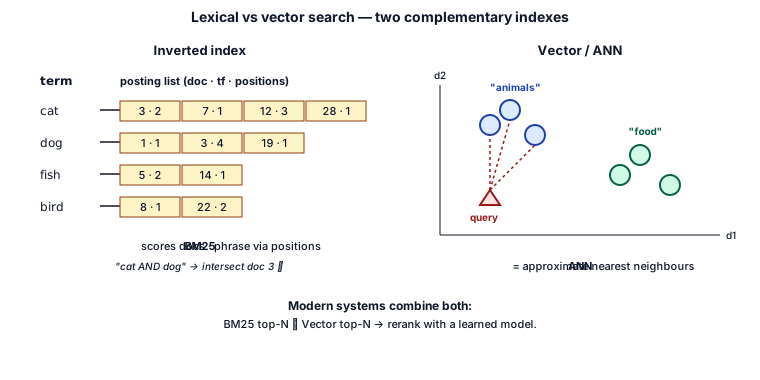
Two families of search: lexical (tokens → inverted index → BM25 / TF-IDF) and vector (embed → ANN index → cosine similarity). Modern systems combine both ("hybrid search").
Inverted index#
flowchart TB
  subgraph Build[Index build]
    Docs[Documents]
    Tok[Tokenise + normalise<br/>lowercase, stop, stem]
    Post[Per-term postings list<br/>doc_id, positions, tf]
    Seg[(Immutable segment)]
    Merge[Background merge]
  end
  subgraph Query[Query path]
    QP[Parse query]
    QT[Per-term postings fetch]
    Intersect[AND / OR / phrase / proximity]
    Score[BM25 score per doc]
    Topk[Top-k heap]
  end
  Docs --> Tok --> Post --> Seg --> Merge
  QP --> QT --> Intersect --> Score --> Topk
  Seg --> QT

    classDef client fill:#dbeafe,stroke:#1e40af,stroke-width:1px,color:#0f172a;
    classDef edge fill:#cffafe,stroke:#0e7490,stroke-width:1px,color:#0f172a;
    classDef service fill:#fef3c7,stroke:#92400e,stroke-width:1px,color:#0f172a;
    classDef datastore fill:#fee2e2,stroke:#991b1b,stroke-width:1px,color:#0f172a;
    classDef cache fill:#fed7aa,stroke:#9a3412,stroke-width:1px,color:#0f172a;
    classDef queue fill:#ede9fe,stroke:#5b21b6,stroke-width:1px,color:#0f172a;
    classDef compute fill:#d1fae5,stroke:#065f46,stroke-width:1px,color:#0f172a;
    classDef storage fill:#e5e7eb,stroke:#374151,stroke-width:1px,color:#0f172a;
    classDef external fill:#fce7f3,stroke:#9d174d,stroke-width:1px,color:#0f172a;
    classDef obs fill:#f3e8ff,stroke:#6b21a8,stroke-width:1px,color:#0f172a;
    class Docs,Tok,Post,Merge,QP,QT,Intersect,Score,Topk service;
    class Seg datastore;
A posting for term cat:
BM25#
The de-facto ranker. For a query Q with terms q_i and a doc D:
Knobs: k_1 (term frequency saturation, ~1.2), b (length normalisation, ~0.75).
TF-IDF (predecessor)#
- Term frequency × inverse document frequency.
- Doesn't saturate; long docs win unfairly. BM25 fixes both.
Phrase / proximity#
- Use position lists to detect
"data center"as adjacent tokens. - Skip lists in the postings make intersection O(min(p1, p2)).
Sharding the index#
- Shard by doc id range: each shard has all terms for its docs (sub-set of docs). Queries fan out to all shards.
- Shard by term: each shard owns a subset of terms - cheaper for some queries but skewed (rare terms vs common).
- Most production systems shard by doc id.
Vector / semantic search#
flowchart TB
  T[Text / image]
  E[Embedding model<br/>BERT / CLIP / SBERT]
  V[Vector - 512 to 4096 dim]
  IDX[(ANN index<br/>HNSW / IVF-PQ / ScaNN)]
  Q[Query embedding]
  KNN[k-NN search]
  T --> E --> V --> IDX
  Q --> IDX
  IDX --> KNN

    classDef client fill:#dbeafe,stroke:#1e40af,stroke-width:1px,color:#0f172a;
    classDef edge fill:#cffafe,stroke:#0e7490,stroke-width:1px,color:#0f172a;
    classDef service fill:#fef3c7,stroke:#92400e,stroke-width:1px,color:#0f172a;
    classDef datastore fill:#fee2e2,stroke:#991b1b,stroke-width:1px,color:#0f172a;
    classDef cache fill:#fed7aa,stroke:#9a3412,stroke-width:1px,color:#0f172a;
    classDef queue fill:#ede9fe,stroke:#5b21b6,stroke-width:1px,color:#0f172a;
    classDef compute fill:#d1fae5,stroke:#065f46,stroke-width:1px,color:#0f172a;
    classDef storage fill:#e5e7eb,stroke:#374151,stroke-width:1px,color:#0f172a;
    classDef external fill:#fce7f3,stroke:#9d174d,stroke-width:1px,color:#0f172a;
    classDef obs fill:#f3e8ff,stroke:#6b21a8,stroke-width:1px,color:#0f172a;
    class T,V,KNN service;
    class IDX datastore;
    class E,Q compute;
ANN structures#
- HNSW - small-world graph; fast recall, RAM-hungry. Most popular.
- IVF + PQ - coarse cluster + product-quantised residuals. Memory-efficient.
- ScaNN - Google's hybrid; great quality / latency.
- DiskANN - SSD-backed for billion-scale.
Hybrid search#
- Lexical (BM25) returns top 200.
- Vector returns top 200.
- Reciprocal-rank fusion or learned-to-rank reranks. Both signals matter - pure vector misses brand names; pure lexical misses synonyms.
Real-time freshness#
- Lucene/ES uses immutable segments + soft commits (visible within seconds).
- Trade-off: smaller segments = faster freshness, more merge overhead.
Caches in front of search#
- Query cache (whole-query top-k).
- Filter cache (e.g. "language=en" bitsets).
- Field-data cache (sort + aggregations).
Where this shows up#
- Search engine (tier 8) - direct application.
- Recommendation system - ANN over user/item embeddings.
- Autocomplete - trie + ranker = lightweight inverted index.
- Spam / abuse detection - vector similarity for near-dup content.
Glossary & fundamentals#
Concepts referenced in this design. Each row links to its canonical page; the tag column shows whether it is a high-level (HLD) or low-level (LLD) concept.
| Tag | Concept | What it is | Page |
|---|---|---|---|
HLD |
Sharding | horizontal partitioning across nodes | database-sharding |
HLD |
Search internals | inverted index, BM25, embeddings, ANN | search-internals |
LLD |
Data structures & complexity | Big-O, common DS, latency numbers | data-structures-complexity |
LLD |
Immutability | immutable types, persistent collections | immutability |
Quick reference#
Lucene segment lifecycle#
- In-memory buffer → flush → immutable segment.
- Many small segments → merge into fewer larger ones.
- Deletes are tombstones; freed at merge.
Tokenisation pitfalls#
- CJK languages need n-gram or ICU analysers, not whitespace.
- URLs / code / log lines need keyword analysers (no stemming).
- Synonyms expanded at index time (precise) or query time (flexible) - both have trade-offs.
Embedding model choice (2024+)#
- General text: OpenAI text-embedding-3, Cohere embed-multilingual, BGE.
- Code: voyage-code-2.
- Images / video: CLIP, OpenCLIP.
- Pick a dim that fits memory: 512-d × 1B vectors × 4 bytes = 2 TB.
Latency budget (typical search)#
- p99 budget: 100-300 ms.
- Allocate: parse 5 ms, candidate fan-out 30 ms, score 30 ms, hydrate 20 ms, ranker 50 ms.
When you don't need a search engine#
- Single table, < 100k rows - Postgres full-text (
tsvector) is fine. - Strict exact-match: indexed columns + B-tree.
Refs#
- "Lucene in Action" (still relevant).
- Elasticsearch internals docs.
- "Pretrained Transformers as Universal Computation Engines" (modern embeddings).
- Faiss / HNSWlib / ScaNN repos.
- "BM25 explained" - Trey Grainger talk.
FAQ#
What is an inverted index?#
An inverted index maps every term to the list of documents that contain it. Lookups become a fast intersection of posting lists instead of scanning every document.
How do BM25 and TF-IDF differ?#
TF-IDF weights terms by raw frequency and inverse document frequency. BM25 adds saturation so repeating a term has diminishing returns and corrects for document length, giving better real-world ranking.
How does Elasticsearch keep search fresh?#
Documents are buffered in memory and refreshed into searchable Lucene segments roughly every second. Background merges combine small segments into larger ones for query efficiency.
When should I use hybrid search?#
When users mix keyword queries with semantic intent. BM25 catches exact matches and rare terms while a vector index finds paraphrases and synonyms, then a reranker fuses both lists.
How do you shard a search index?#
Hash documents by id across primary shards for write balance, replicate each shard for read scale and failover, and route queries to all shards then merge top-K results at the coordinator.
Related Topics#
- Caching Strategies: search systems cache query results and index segments to reduce latency for popular queries
- Consistent Hashing: search index shards are distributed across nodes using consistent hashing for balanced load
- Probabilistic Data Structures: search engines use Bloom filters and min-hash for near-duplicate detection and efficient index lookups
Further reading#
Curated, high-credibility sources for going deeper on this topic.