Threading & Deadlocks#
flowchart LR
  T1[Thread A<br/>holds L1, wants L2]
  T2[Thread B<br/>holds L2, wants L1]
  L1([Lock 1])
  L2([Lock 2])
  T1 -- holds --> L1
  T2 -- holds --> L2
  T1 -- waits --> L2
  T2 -- waits --> L1

  classDef p fill:#dbeafe,stroke:#1e40af,stroke-width:1px,color:#0f172a;
  classDef s fill:#fef3c7,stroke:#92400e,stroke-width:1px,color:#0f172a;
  class T1,T2 p;
  class L1,L2 s;

    classDef client fill:#dbeafe,stroke:#1e40af,stroke-width:1px,color:#0f172a;
    classDef edge fill:#cffafe,stroke:#0e7490,stroke-width:1px,color:#0f172a;
    classDef service fill:#fef3c7,stroke:#92400e,stroke-width:1px,color:#0f172a;
    classDef datastore fill:#fee2e2,stroke:#991b1b,stroke-width:1px,color:#0f172a;
    classDef cache fill:#fed7aa,stroke:#9a3412,stroke-width:1px,color:#0f172a;
    classDef queue fill:#ede9fe,stroke:#5b21b6,stroke-width:1px,color:#0f172a;
    classDef compute fill:#d1fae5,stroke:#065f46,stroke-width:1px,color:#0f172a;
    classDef storage fill:#e5e7eb,stroke:#374151,stroke-width:1px,color:#0f172a;
    classDef external fill:#fce7f3,stroke:#9d174d,stroke-width:1px,color:#0f172a;
    classDef obs fill:#f3e8ff,stroke:#6b21a8,stroke-width:1px,color:#0f172a;
    class T1,T2,L1,L2 service;
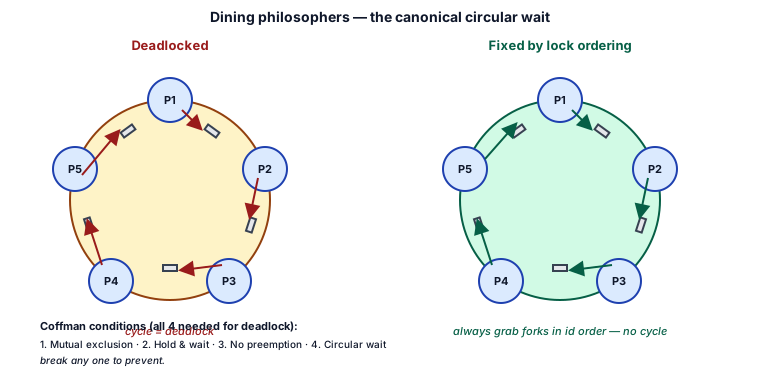
A deadlock happens when two or more threads form a cycle of "I hold this, I want yours". Prevention is about breaking the four Coffman conditions: mutual exclusion, hold-and-wait, no preemption, circular wait.
Thread states#
stateDiagram-v2
  [*] --> New
  New --> Runnable : start()
  Runnable --> Running : scheduler picks it
  Running --> Runnable : preempt
  Running --> Waiting : wait() / await condition
  Waiting --> Runnable : notify / signal
  Running --> TimedWaiting : sleep / join with timeout
  TimedWaiting --> Runnable : time elapses / signal
  Running --> Blocked : try to take a held lock
  Blocked --> Runnable : lock released
  Running --> [*] : run() returns
Threading models#
| Model | Example | Trade-off |
|---|---|---|
| 1:1 (OS threads) | Java, Linux pthreads | full preemption, ~MB stack each |
| N:1 (user threads) | early Erlang | no preemption, cheap |
| M:N (mix) | Go goroutines, Erlang BEAM, Java loom (virtual threads) | cheap fibres mapped to OS threads |
| Single-threaded + event loop | Node.js, Redis | no shared-mutable concurrency, async I/O |

Coffman conditions for deadlock#
All four must hold for a deadlock: 1. Mutual exclusion - a resource is held exclusively. 2. Hold and wait - a thread holds one and asks for another. 3. No preemption - the system can't forcibly take the resource. 4. Circular wait - a cycle of holders.
Break any one to prevent deadlock.
Prevention strategies#
| Strategy | How | Cost |
|---|---|---|
| Lock ordering | always acquire locks in a global order (e.g. by id) | requires discipline; works in single process |
tryLock with timeout |
back off + retry on contention | may livelock; use jitter |
| Lock coarsening | one big lock | low concurrency |
| Lock-free / atomics | no locks, CAS loops | hard to design correctly |
| Resource leveling / pre-allocation | grab all needed resources up front | wastes capacity |
| Wait-die / wound-wait (classic DB) | older tx wins / kills younger | aborts increase |
| Detection + abort | run-time cycle detection, then rollback one | needed for arbitrary tx ordering (DBs do this) |
Lock ordering example#
For "transfer money from account A to account B":
void transfer(Account a, Account b, BigDecimal amt) {
  Account first  = a.id < b.id ? a : b;
  Account second = a.id < b.id ? b : a;
  synchronized (first) {
    synchronized (second) {
      a.debit(amt);
      b.credit(amt);
    }
  }
}
Without ordering, two simultaneous transfers in opposite directions deadlock.
Detection at runtime#
- Java:
jstackshows held & waited-on locks; the JVM prints "Found one Java-level deadlock" when it can. - PostgreSQL:
pg_stat_activity+pg_locks; configureddeadlock_timeouttriggers detection. - OS: tools like
valgrind --tool=helgrind,tsan(ThreadSanitizer).
Related hazards#
- Livelock - threads stay active, keep yielding, never make progress. Common with poorly-tuned
tryLock + retry. - Starvation - a low-priority thread is perpetually skipped. Use fair locks (
ReentrantLock(true)). - Priority inversion - high-priority waits for low-priority holding the lock. Solved by priority inheritance.
Where this shows up in this site#
- Stock exchange - avoids the whole class of problems by going single-threaded per symbol.
- Distributed lock service - fencing tokens prevent the network-scale version of "no preemption".
- Banking / wallet transfers - lock ordering by account id.
- Calendar event RSVP - optimistic concurrency to avoid lock cycles.
Glossary & fundamentals#
Concepts referenced in this design. Each row links to its canonical page; the tag column shows whether it is a high-level (HLD) or low-level (LLD) concept.
| Tag | Concept | What it is | Page |
|---|---|---|---|
HLD |
Idempotency & retries | safe re-execution, backoff + jitter | idempotency-retries |
LLD |
Async models | futures / async-await / coroutines / actors | async-models |
LLD |
OOP pillars | encapsulation, abstraction, inheritance, polymorphism | oop-pillars |
LLD |
Behavioural patterns | Strategy, Observer, State, Command, Chain | behavioral-patterns |
LLD |
Concurrency primitives | mutex, semaphore, RW lock, atomic, CAS | concurrency-primitives |
LLD |
Threading & deadlocks | thread states, Coffman, lock ordering | threading-and-deadlocks |
Quick reference#
Debugging deadlocks#
- Reproduce: stress-test with many threads.
- Snapshot stacks (
jstack,gdb thread apply all bt,tsan). - Look for cycles in the held-vs-waiting lock graph.
- Time-bound
tryLockto surface deadlocks fast in tests.
Designing them out#
- Hold one lock at a time when possible.
- If you must hold multiple, define a global lock-ordering policy.
- Prefer message-passing (channels, actors, Kafka) over shared mutable state.
- Keep critical sections short; never call out into unknown code while holding a lock.
Lock-free isn't a silver bullet#
Lock-free algorithms have their own hazards: ABA, livelocks, memory-ordering bugs. Use battle-tested data structures (ConcurrentHashMap, java.util.concurrent.atomic, c++ std::atomic, Go channels).
Refs#
- Java Concurrency in Practice - chapter 10 (avoiding liveness hazards).
- Edsger Dijkstra: original treatment of dining philosophers.
- The Linux RT-locking and priority inheritance discussions.
- PostgreSQL docs: deadlocks & advisory locks.
FAQ#
What is a deadlock in multithreading?#
A deadlock is when two or more threads each wait for a lock the other holds, so none can make progress. All four Coffman conditions must be true at once.
What are the four Coffman conditions for deadlock?#
Mutual exclusion, hold and wait, no preemption, and circular wait. Breaking any one of them prevents deadlocks from forming.
How do I prevent deadlocks?#
Always acquire locks in a globally consistent order, use try-lock with timeouts, or replace fine-grained locks with a single coarse lock when contention permits.
What is the difference between deadlock and livelock?#
In deadlock no thread progresses. In livelock threads keep changing state in response to each other but never finish, like two people sidestepping in a hallway.
How do databases detect deadlocks?#
Most engines build a wait-for graph and look for cycles. When one is found they abort the cheapest victim, which then retries. Postgres and MySQL both do this.
Related Topics#
- Concurrency Primitives: mutexes, semaphores, and monitors are the primitives involved in deadlock scenarios
- Async Models: async and actor models reduce shared-state concurrency and the risk of deadlocks
- Error Handling: detecting and recovering from liveness failures like deadlock and livelock
Further reading#
Curated, high-credibility sources for going deeper on this topic.