HTTP / TLS protocols#
Problem statement (interviewer prompt)
Explain the differences between HTTP/1.1, HTTP/2 and HTTP/3 (over QUIC), and pick the right one for a mobile-first product on lossy networks. Cover head-of-line blocking, multiplexing, the TLS 1.3 handshake, and where 0-RTT is safe.
flowchart LR
  C([Client])
  H1[HTTP 1.1<br/>text, keep-alive]
  H2[HTTP 2<br/>binary, multiplex over TCP]
  H3[HTTP 3 - QUIC<br/>multiplex over UDP]
  T[TLS 1.3<br/>1-RTT or 0-RTT]
  S[Server]
  C --> T --> H1
  C --> T --> H2
  C --> T --> H3
  H1 --> S
  H2 --> S
  H3 --> S

    classDef client fill:#dbeafe,stroke:#1e40af,stroke-width:1px,color:#0f172a;
    classDef edge fill:#cffafe,stroke:#0e7490,stroke-width:1px,color:#0f172a;
    classDef service fill:#fef3c7,stroke:#92400e,stroke-width:1px,color:#0f172a;
    classDef datastore fill:#fee2e2,stroke:#991b1b,stroke-width:1px,color:#0f172a;
    classDef cache fill:#fed7aa,stroke:#9a3412,stroke-width:1px,color:#0f172a;
    classDef queue fill:#ede9fe,stroke:#5b21b6,stroke-width:1px,color:#0f172a;
    classDef compute fill:#d1fae5,stroke:#065f46,stroke-width:1px,color:#0f172a;
    classDef storage fill:#e5e7eb,stroke:#374151,stroke-width:1px,color:#0f172a;
    classDef external fill:#fce7f3,stroke:#9d174d,stroke-width:1px,color:#0f172a;
    classDef obs fill:#f3e8ff,stroke:#6b21a8,stroke-width:1px,color:#0f172a;
    class C client;
    class H1,H2,H3,T,S service;
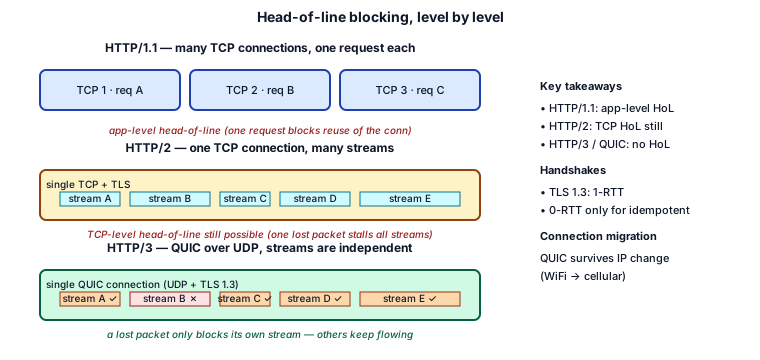
Three generations of HTTP solve the same problem at different layers: HTTP/1.1 is text + connection-per-request, HTTP/2 multiplexes streams over one TCP connection, HTTP/3 moves multiplexing to QUIC over UDP to avoid head-of-line blocking.
flowchart TB
  subgraph V1[HTTP 1.1 - 1997]
    direction TB
    A1[Text framing]
    A2[Keep-alive connections]
    A3[Pipelining - rarely used]
    A4[Head-of-line block at app layer]
  end
  subgraph V2[HTTP 2 - 2015]
    direction TB
    B1[Binary framing]
    B2[Multiplexed streams over 1 TCP]
    B3[Header compression - HPACK]
    B4[Server push - deprecated 2022]
    B5[TCP HoL still possible]
  end
  subgraph V3[HTTP 3 - 2022, QUIC]
    direction TB
    C1[UDP transport]
    C2[Multiplexed streams - independent]
    C3[Built-in TLS 1.3]
    C4[0-RTT resumption]
    C5[Connection migration]
  end
  subgraph TLSv[TLS 1.3 - 2018]
    D1[1-RTT handshake]
    D2[0-RTT data replay risk]
    D3[ECDHE + AEAD only]
    D4[mTLS for service-to-service]
  end
  V1 --> V2 --> V3
  TLSv --- V1
  TLSv --- V2
  TLSv --- V3

    classDef client fill:#dbeafe,stroke:#1e40af,stroke-width:1px,color:#0f172a;
    classDef edge fill:#cffafe,stroke:#0e7490,stroke-width:1px,color:#0f172a;
    classDef service fill:#fef3c7,stroke:#92400e,stroke-width:1px,color:#0f172a;
    classDef datastore fill:#fee2e2,stroke:#991b1b,stroke-width:1px,color:#0f172a;
    classDef cache fill:#fed7aa,stroke:#9a3412,stroke-width:1px,color:#0f172a;
    classDef queue fill:#ede9fe,stroke:#5b21b6,stroke-width:1px,color:#0f172a;
    classDef compute fill:#d1fae5,stroke:#065f46,stroke-width:1px,color:#0f172a;
    classDef storage fill:#e5e7eb,stroke:#374151,stroke-width:1px,color:#0f172a;
    classDef external fill:#fce7f3,stroke:#9d174d,stroke-width:1px,color:#0f172a;
    classDef obs fill:#f3e8ff,stroke:#6b21a8,stroke-width:1px,color:#0f172a;
    class A1,A2,A3,A4,B1,B2,B3,B4,B5,C1,C2,C3,C4,C5,D1,D2,D3,D4 service;
Side-by-side#
| HTTP/1.1 | HTTP/2 | HTTP/3 | |
|---|---|---|---|
| Transport | TCP | TCP | QUIC over UDP |
| Framing | text lines | binary frames | binary frames |
| Multiplex | parallel TCP conns | streams in one conn | streams in one conn |
| Header compression | none | HPACK | QPACK |
| Head-of-line block | app + TCP | TCP only | none |
| Handshake | 1-3 RTT (with TLS) | 1-3 RTT | 1 RTT, often 0-RTT |
| Server push | no | yes (now rare) | discouraged |
When does each matter#
- Mobile + lossy networks → HTTP/3 wins (QUIC handles packet loss per-stream).
- High-throughput backends → HTTP/2 is enough; gRPC uses it.
- Legacy intermediaries / corporate proxies → may still need HTTP/1.1 fallback.
- Anything internet-facing → terminate at edge with TLS 1.3 + HTTP/3.
TLS 1.3 anatomy#
sequenceDiagram
  participant C as Client
  participant S as Server
  C->>S: ClientHello + key share + ALPN
  S-->>C: ServerHello + key share + cert + finished
  C->>S: finished + application data
  Note over C,S: 1 round-trip total
- ALPN selects HTTP/1.1 / 2 / 3 inside the TLS handshake.
- 0-RTT data is replayable - only safe for idempotent requests.
- mTLS adds a client cert; common for service-to-service inside a zero-trust mesh.
Common interview hooks#
- "Why is HTTP/2 still vulnerable to head-of-line blocking?" → TCP loss stalls every stream.
- "When would you keep HTTP/1.1?" → simple proxies, debugging, anything that can't speak h2.
- "How does QUIC achieve connection migration?" → connection id, not 5-tuple; survives IP change.
Glossary & fundamentals#
Concepts referenced in this design. Each row links to its canonical page; the tag column shows whether it is a high-level (HLD) or low-level (LLD) concept.
| Tag | Concept | What it is | Page |
|---|---|---|---|
HLD |
HTTP / TLS protocols | HTTP 1.1/2/3, QUIC, TLS 1.3 | http-protocols |
HLD |
Service mesh | sidecar mesh, mTLS, traffic policy | service-mesh |
Quick reference#
Numbers worth memorising#
- TLS 1.3 handshake: 1 RTT (0-RTT for resumption).
- HTTP/2 default max concurrent streams: 100.
- HPACK dynamic table default: 4 KB.
- QUIC default idle timeout: 30 s.
Practical advice#
- Don't terminate TLS in app servers - use a dedicated edge (NGINX, Envoy, ALB).
- Force HTTPS at edge; HSTS with
preloadif you control all subdomains. - Pre-load certs into HSM/KMS; rotate via ACME (Let's Encrypt).
- Pin cipher list to TLS 1.3 AEAD only internally.
- HTTP/2 over plaintext (h2c) is technically allowed but no browser supports it.
Gotchas#
Connection: closedefeats keep-alive (slow performance).- gRPC over HTTP/2 - long-lived streams + RST_STREAM mid-call for cancellation.
- HTTP/2 server push is effectively dead (Chrome 106 removed support).
- 0-RTT replay attacks - never use for non-idempotent ops.
Refs#
- RFC 9110/9112 (HTTP/1.1), RFC 9113 (HTTP/2), RFC 9114 (HTTP/3).
- RFC 8446 (TLS 1.3).
- High Performance Browser Networking - Ilya Grigorik (free online).
- Cloudflare blog on QUIC migration.
FAQ#
What is the difference between HTTP/1.1, HTTP/2 and HTTP/3?#
HTTP/1.1 is text and one request per connection. HTTP/2 is binary multiplexed over one TCP connection. HTTP/3 multiplexes over QUIC on UDP, dodging TCP head-of-line blocking.
Why is HTTP/3 better on mobile networks?#
QUIC streams are independent, so a single lost packet only stalls one stream. It also resumes connections after IP changes, helping cellular handoff and Wi-Fi switches.
How does the TLS 1.3 handshake work?#
Client and server exchange key shares in a single round trip and immediately derive session keys, so encrypted application data flows after just 1 RTT.
When is TLS 1.3 0-RTT safe?#
Only for idempotent requests like GETs. Replay protection is weaker for 0-RTT data, so non-idempotent operations like payments must wait for the full handshake.
What is head-of-line blocking?#
When one packet or request is delayed, all packets behind it in the same connection wait too. HTTP/2 has it at the TCP layer; HTTP/3 over QUIC removes it per stream.
Related Topics#
- API Gateway: API gateways implement HTTP protocol handling, routing, and header manipulation at the edge
- CDN: CDNs rely on HTTP caching semantics and HTTP/2 multiplexing to optimize content delivery
- Service Mesh: service meshes use HTTP/2 and gRPC as the primary protocols for service-to-service traffic
Further reading#
Curated, high-credibility sources for going deeper on this topic.
- 📜 RFC - RFC 9110 - HTTP Semantics
- 📜 RFC - RFC 9113 - HTTP/2
- 📜 RFC - RFC 9114 - HTTP/3
- 📜 RFC - RFC 8446 - TLS 1.3
- 📘 Book - Ilya Grigorik - High Performance Browser Networking (free online)