Data Structures & Complexity#
Problem statement (interviewer prompt)
For each of these scenarios, pick the data structure: 'is this URL one of 10 billion seen?', 'top-10 hashtags this minute', 'O(1) cache by key', 'priority job queue', 'cursor pagination over sorted items', 'autocomplete prefix lookup'. Justify each with Big-O.
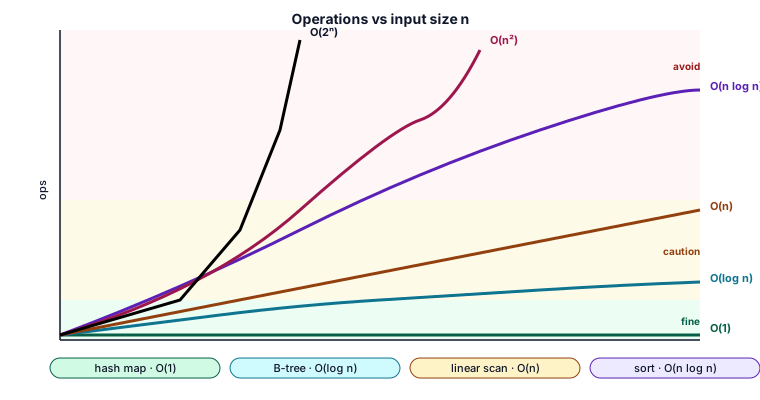
flowchart LR
  C[O 1 - constant]
  L[O log n - log]
  N[O n - linear]
  NL[O n log n - linearithmic]
  N2[O n^2 - quadratic]
  E[O 2^n - exponential]
  C --> L --> N --> NL --> N2 --> E

  classDef g fill:#d1fae5,stroke:#065f46,stroke-width:1px,color:#0f172a;
  classDef y fill:#fef3c7,stroke:#92400e,stroke-width:1px,color:#0f172a;
  classDef r fill:#fee2e2,stroke:#991b1b,stroke-width:1px,color:#0f172a;
  class C,L g;
  class N,NL y;
  class N2,E r;

    classDef client fill:#dbeafe,stroke:#1e40af,stroke-width:1px,color:#0f172a;
    classDef edge fill:#cffafe,stroke:#0e7490,stroke-width:1px,color:#0f172a;
    classDef service fill:#fef3c7,stroke:#92400e,stroke-width:1px,color:#0f172a;
    classDef datastore fill:#fee2e2,stroke:#991b1b,stroke-width:1px,color:#0f172a;
    classDef cache fill:#fed7aa,stroke:#9a3412,stroke-width:1px,color:#0f172a;
    classDef queue fill:#ede9fe,stroke:#5b21b6,stroke-width:1px,color:#0f172a;
    classDef compute fill:#d1fae5,stroke:#065f46,stroke-width:1px,color:#0f172a;
    classDef storage fill:#e5e7eb,stroke:#374151,stroke-width:1px,color:#0f172a;
    classDef external fill:#fce7f3,stroke:#9d174d,stroke-width:1px,color:#0f172a;
    classDef obs fill:#f3e8ff,stroke:#6b21a8,stroke-width:1px,color:#0f172a;
    class C,L,N,NL,N2,E service;
A quick reference: time + space costs for the data structures you'll reach for in any LLD problem. Pick by the operation you do most, not by what feels familiar.
Cheat sheet (average case)#
| Structure | Access | Search | Insert | Delete | Notes |
|---|---|---|---|---|---|
| Array | O(1) | O(n) | O(n) | O(n) | contiguous, cache-friendly |
| Dynamic array (Vector / ArrayList) | O(1) | O(n) | O(1) amortised | O(n) | doubling growth |
| Linked list | O(n) | O(n) | O(1) at known position | O(1) | cache-unfriendly |
| Stack | O(1) | O(n) | O(1) | O(1) | LIFO |
| Queue | O(1) | O(n) | O(1) | O(1) | FIFO |
| Deque | O(1) | O(n) | O(1) | O(1) | double-ended |
| Hash map | O(1)* | O(1)* | O(1)* | O(1)* | worst case O(n) on bad hash |
| Tree map / Red-Black tree | O(log n) | O(log n) | O(log n) | O(log n) | ordered |
| Heap (binary) | O(1) peek | O(n) | O(log n) | O(log n) | priority queue |
| Trie | O(k) | O(k) | O(k) | O(k) | k = key length |
| B-tree / B+ tree | O(log n) | O(log n) | O(log n) | O(log n) | disk-friendly, DB indexes |
| Skip list | O(log n) | O(log n) | O(log n) | O(log n) | simpler than RB-tree |
| Bloom filter | O(k) | O(k) | O(k) | n/a | probabilistic; no remove |
| Disjoint set / Union-Find | O(α(n)) ≈ O(1) | n/a | O(α(n)) | n/a | with path compression + union by rank |
| Graph (adj list) | n/a | varies | O(1) edge | O(deg) | sparse graphs |
| Graph (adj matrix) | O(1) edge | O(n²) | O(1) | O(1) | dense graphs |
| LSM tree | O(log n) | O(log n) avg | O(log n) | O(log n) | write-optimised, see storage engines |
* hash: amortised; worst case O(n) on collisions or adversarial input.
When to pick what#
flowchart TB
  Q[What's the dominant op?]
  Q --> A[fast lookup by key] --> AH[Hash map]
  Q --> B[ordered iteration] --> BT[Tree map / B-tree]
  Q --> C[get min / max repeatedly] --> CH[Heap]
  Q --> D[prefix search / autocomplete] --> DT[Trie]
  Q --> E[set membership, no removes, ok with FP] --> EB[Bloom filter]
  Q --> F[range queries] --> FT[B-tree, segment tree]
  Q --> G[append-only log] --> GL[Vector / log-structured]
  Q --> H[disjoint groups + union] --> HU[Union-Find]
  Q --> I[graph traversal] --> IG[Adjacency list]

  classDef p fill:#fef3c7,stroke:#92400e,stroke-width:1px,color:#0f172a;
  class A,B,C,D,E,F,G,H,I p;

    classDef client fill:#dbeafe,stroke:#1e40af,stroke-width:1px,color:#0f172a;
    classDef edge fill:#cffafe,stroke:#0e7490,stroke-width:1px,color:#0f172a;
    classDef service fill:#fef3c7,stroke:#92400e,stroke-width:1px,color:#0f172a;
    classDef datastore fill:#fee2e2,stroke:#991b1b,stroke-width:1px,color:#0f172a;
    classDef cache fill:#fed7aa,stroke:#9a3412,stroke-width:1px,color:#0f172a;
    classDef queue fill:#ede9fe,stroke:#5b21b6,stroke-width:1px,color:#0f172a;
    classDef compute fill:#d1fae5,stroke:#065f46,stroke-width:1px,color:#0f172a;
    classDef storage fill:#e5e7eb,stroke:#374151,stroke-width:1px,color:#0f172a;
    classDef external fill:#fce7f3,stroke:#9d174d,stroke-width:1px,color:#0f172a;
    classDef obs fill:#f3e8ff,stroke:#6b21a8,stroke-width:1px,color:#0f172a;
    class Q,A,AH,B,BT,C,CH,D,E,EB,F,FT,G,GL,H,HU,I,IG service;
    class DT datastore;
Common interview algos + complexity#
| Problem | Algorithm | Time | Space |
|---|---|---|---|
| Sort | Merge / Heap / Quick | O(n log n) | O(n) / O(1) |
| Shortest path (no neg weights) | Dijkstra | O((V+E) log V) | O(V) |
| Shortest path (neg weights ok) | Bellman-Ford | O(VE) | O(V) |
| All-pairs shortest path | Floyd-Warshall | O(V³) | O(V²) |
| Topological sort | Kahn's algo | O(V+E) | O(V) |
| Connected components | DFS/BFS or Union-Find | O(V+E) / O(α·E) | O(V) |
| MST | Prim / Kruskal | O(E log V) | O(V+E) |
| Cycle detection | DFS with colors | O(V+E) | O(V) |
| Strongly connected components | Tarjan / Kosaraju | O(V+E) | O(V) |
| String search | KMP / Rabin-Karp | O(n+m) | O(m) |
| Longest common subseq | DP | O(nm) | O(nm) |
Space-time trade-offs#
| Want to optimise | Pay with |
|---|---|
| Read latency | denormalisation, caches |
| Write latency | append-only, batch flush |
| Memory | probabilistic structures, compression |
| Hot keys | sharding, replication |
| Network | colocation, batching |
Amortised cost#
- ArrayList push: O(1) amortised even though occasional resizes are O(n).
- Union-Find with path compression: ~O(1).
- Hash map resize: O(n) every doubling; amortised O(1) per insert.
Memory model nuance#
- Linked list = pointer chasing → many cache misses.
- Array of structs > struct of arrays for sequential access.
- 4 KB page is the typical access granularity from disk.
Glossary & fundamentals#
Concepts referenced in this design. Each row links to its canonical page; the tag column shows whether it is a high-level (HLD) or low-level (LLD) concept.
| Tag | Concept | What it is | Page |
|---|---|---|---|
HLD |
Sharding | horizontal partitioning across nodes | database-sharding |
HLD |
Leader/follower replication | sync/semi-sync/async replication, failover | replication-leader-follower |
HLD |
LSM vs B-Tree engines | WAL, memtable, SSTables, compaction | storage-engines-lsm-btree |
HLD |
Probabilistic data structures | Bloom, HLL, Count-Min, MinHash, t-digest | probabilistic-data-structures |
LLD |
Data structures & complexity | Big-O, common DS, latency numbers | data-structures-complexity |
Quick reference#
Interview heuristic#
Before writing code, say out loud: "I'll use X because the dominant operation is Y, which is O(_) on X." That single sentence wins.
Practical numbers (worth memorising)#
- Cache line: 64 B.
- DRAM access: ~100 ns.
- L1 access: ~1 ns. So a cache miss is ~100× slower.
- Branch mispredict: ~5 ns.
- Atomic CAS uncontended: ~20 ns. Contended: 100s of ns.
These numbers turn "Big-O" reasoning into latency reasoning when it matters.
When O(n²) is fine#
- n ≤ 1000.
- All-pairs algorithms on small graphs.
- Anything one-shot, run offline.
When O(n log n) becomes O(n)#
- Counting / radix / bucket sort when the universe is small.
- Top-k with a heap of size k: O(n log k), not O(n log n).
When O(log n) becomes O(1)#
- Hash maps (with caveats).
- Bloom filters / count-min for probabilistic answers.
Refs#
- "Introduction to Algorithms" - Cormen et al. (CLRS).
- "Algorithms" - Sedgewick & Wayne (book + Coursera).
- bigocheatsheet.com.
- "Numbers Everyone Should Know" (Jeff Dean, ~2010).
FAQ#
How do I pick the right data structure?#
Start from the operations the workload needs and their target Big-O. Hash map for O(1) keyed access, heap for top-K, trie for prefix lookup, bloom filter for probabilistic membership, sorted set for ranges.
When should I use a bloom filter?#
When you need fast membership tests on a huge set and can tolerate a small false-positive rate. Common uses are cache filters, deduplication, and crawl frontiers.
Heap vs balanced tree for top-K?#
A min-heap of size K gives O(N log K) and is the standard streaming approach. Balanced trees support ordered iteration too but cost more memory and constant factors.
What is the best structure for autocomplete?#
A trie or a radix tree handles prefix queries in O(L) where L is the prefix length. Add weights at nodes for ranked suggestions and prune to top-K during traversal.
How does an LRU cache hit O(1)?#
Combine a hash map for key lookup with a doubly linked list for recency. Hits move the node to the head; evictions drop the tail node, both in constant time.
Related Topics#
- Async Models: understanding time complexity of async queues and event loops
- Concurrency Primitives: lock-free data structures and their complexity trade-offs
Further reading#
Curated, high-credibility sources for going deeper on this topic.